























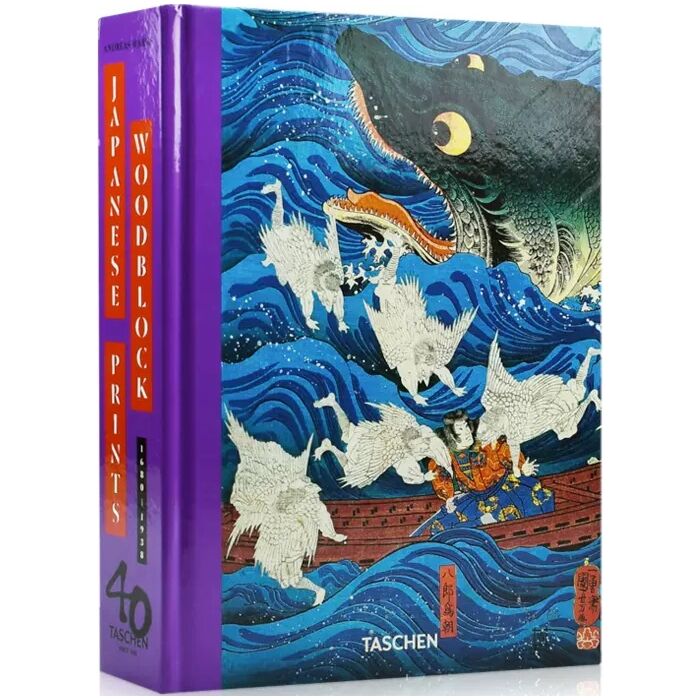
Japanese Woodblock Prints
Паперова книга
В наявності

Special Price
1450₴
ціна
ЄКЛУБ
КРАЩА
ціна
Regular Price
2180₴

Доставка
від 0


Нова Пошта
від 0 до 69 грн
на відділення
69 грн
для замовлень від 799 грн
безкоштовно
в поштомат
65 грн
для замовлень від 599 грн
безкоштовно
Укрпошта
від 0 до 45 грн
на відділення
45 грн
для замовлень від 399 грн
безкоштовно
в поштомат
45 грн
для замовлень від 399 грн
безкоштовно
Meest Пошта
від 0 до 52 грн
на відділення
52 грн
для замовлень від 499 грн
безкоштовно
Оплата
Післяплата, карткою


Післяплата
на пошті при отриманні замовлення
Картою
оплата картою на сайті
Знижка 33%, встигни!
Залишилось:
| Автор | Andreas Marks |
|---|---|
| Видавництво | Taschen |
| Рік видання | 2022 |
| Мова | Англійська |
| Кількість сторінок | 512 |
| Обкладинка | Тверда |
| Вага | 1.241 |
| ISBN | 9783836587532 |
| Формат | 156x217x42мм |
| Серія книг | 40th Edition |
| Тип | Паперова книга |
| Наявність ілюстрацій | Так |
| Перекладна | Ні |
Анотація "Japanese Woodblock Prints", Andreas Marks
From Edouard Manet's portrait of naturalist writer Emile Zola sitting among his Japanese art finds to Van Gogh's meticulous copies of the Hiroshige prints he devotedly collected, 19th-century pioneers of European modernism made no secret of their love of Japanese art. In all its sensuality, freedom, and effervescence, the woodblock print is single-handedly credited with the wave of japonaiserie that first enthralled France and, later, all of Europe-but often remains misunderstood as an "exotic" artifact that helped inspire Western creativity.
The fact is that the Japanese woodblock print is a phenomenon of which there exists no Western equivalent. Some of the most disruptive ideas in modern art-including, as Karl Marx put it, that "all that is solid melts into air"-were invented in Japan in the 1700s and expressed like never before in the designs of such masters as Hokusai, Utamaro, and Hiroshige in the early 19th century.
The fact is that the Japanese woodblock print is a phenomenon of which there exists no Western equivalent. Some of the most disruptive ideas in modern art-including, as Karl Marx put it, that "all that is solid melts into air"-were invented in Japan in the 1700s and expressed like never before in the designs of such masters as Hokusai, Utamaro, and Hiroshige in the early 19th century.
Write Your Own Review
