























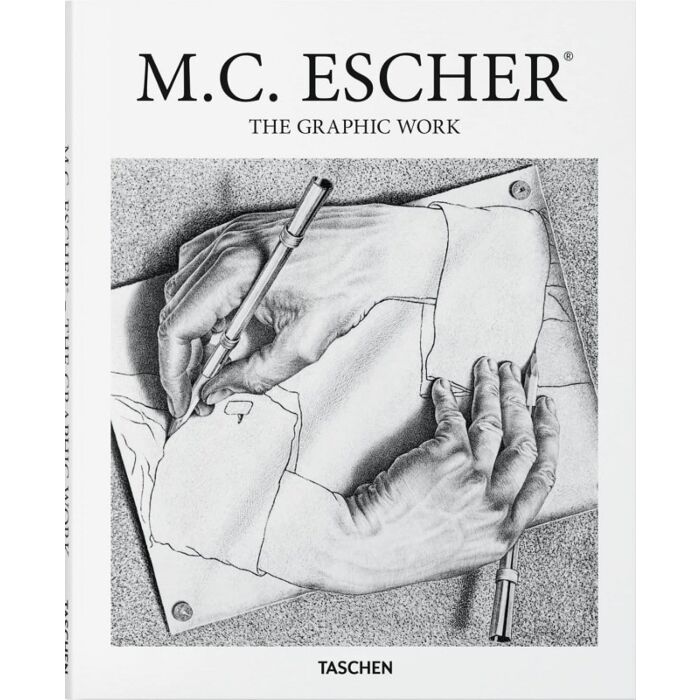
M.C. Escher. The Graphic Work
Паперова книга
Немає в наявності
Special Price
899₴
ціна
ЄКЛУБ
КРАЩА
ціна
Regular Price
1351₴

Доставка
від 0


Нова Пошта
від 0 до 69 грн
на відділення
69 грн
для замовлень від 799 грн
безкоштовно
в поштомат
65 грн
для замовлень від 599 грн
безкоштовно
Укрпошта
від 0 до 45 грн
на відділення
45 грн
для замовлень від 399 грн
безкоштовно
в поштомат
45 грн
для замовлень від 399 грн
безкоштовно
Meest Пошта
від 0 до 52 грн
на відділення
52 грн
для замовлень від 499 грн
безкоштовно
Оплата
Післяплата, карткою


Післяплата
на пошті при отриманні замовлення
Картою
оплата картою на сайті
Знижка 33%, встигни!
Залишилось:
| Автор | M.C. Escher |
|---|---|
| Видавництво | Taschen |
| Рік видання | 2016 |
| Мова | Англійська |
| Кількість сторінок | 96 |
| Обкладинка | Тверда |
| Вага | 0.611 |
| ISBN | 9783836529846 |
| Формат | 210x260x13мм |
| Серія книг | Basic Art |
| Тип | Паперова книга |
| Наявність ілюстрацій | Так |
| Перекладна | Ні |
Анотація "M.C. Escher. The Graphic Work", M.C. Escher
From impossible staircases to tesselated birds, Dutch artist M.C. Escher (1898–1972) crafted a unique graphic language of patterns, puzzles, and mathematics. Dense, complex, and structured by intricate principles, his work is at the same time decorative and playful, toying constantly with optic illusions and the limitations of sensory perception. For mathematicians and scientists, Escher is a mastermind. For hippies, he was the pioneer of psychedelic art.
Born in Leeuwarden, in the Netherlands in 1898, Escher’s early works focused on nature and landscapes, with regular exhibitions in Holland, and some international recognition. It was on a trip to the Alhambra Palace in Spain in the 1920s, however, that Escher found his niche. Sketching the patterns of the palace’s Moorish architecture, Escher became captivated by the codependency of forms within and next to each other.
Born in Leeuwarden, in the Netherlands in 1898, Escher’s early works focused on nature and landscapes, with regular exhibitions in Holland, and some international recognition. It was on a trip to the Alhambra Palace in Spain in the 1920s, however, that Escher found his niche. Sketching the patterns of the palace’s Moorish architecture, Escher became captivated by the codependency of forms within and next to each other.
Write Your Own Review
